
AI Overviews are creating a new local SEO problem: your rankings can look fine while the phone gets quieter.
For years, the basic local search playbook was simple enough to explain in one sentence: rank higher, earn the click, convert the visitor. That chain is breaking. Google can now answer more of the query directly on the results page, which means a local business may still appear in search while fewer people ever reach the website.
The danger is not that SEO is dead. The danger is that old SEO dashboards can say everything is fine while leads are leaking somewhere else.
What Changed
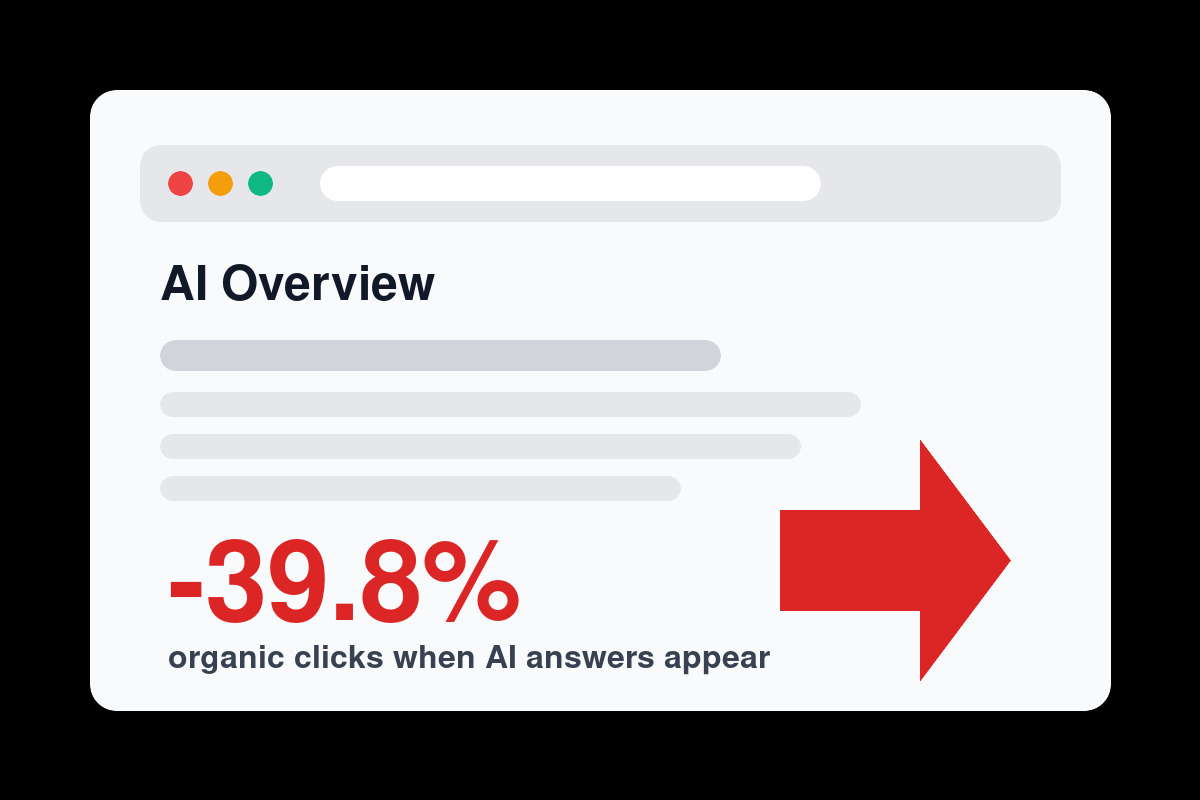
A 2026 randomized field experiment published on SSRN found that, when Google AI Overviews appeared, outbound organic clicks dropped by 39.8%. The same study also reported a 34.5% increase in zero-click searches, while user satisfaction and perceived information quality did not meaningfully improve.
That matters because local SEO has always depended on action. A homeowner does not help your business by merely learning what an HVAC tune-up includes. A restaurant owner does not help your agency by reading a generic answer about local SEO. Revenue happens when the searcher calls, books, requests a quote, or fills out a form.
AI answers move more of that decision-making upstream, before the click.
The Local Business Trap
The obvious reaction is to chase more rankings. That is usually the wrong first move.
A local company can still rank on page one and still lose demand if AI systems summarize the answer, mention competitors, or satisfy the search before the customer opens a site. This creates a measurement trap: rankings hold, impressions may even rise, but calls and forms decline.
That is why the new question is not just, “Where do we rank?” It is:
- Does the business appear inside AI-generated answers?
- Is the business mentioned accurately by ChatGPT, Perplexity, Gemini, and Google AI Mode?
- Do those answers include the right service area, proof, reviews, pricing cues, and next step?
- Can a searcher confirm trust within 30 seconds after landing on the site?
If the website only proves relevance to Google but not trust to the human buyer, AI search will expose that weakness faster.
Why GEO Is Not Just SEO With A New Name
Generative engine optimization, or GEO, is not a replacement for technical SEO, local pages, reviews, citations, or backlinks. Those still matter. But GEO adds another layer: making sure machines can understand, verify, and confidently recommend the business.
That requires different evidence. Strong service pages still need clean headings and fast load times, but they also need details AI systems can reuse: named services, real locations, proof of work, FAQs, comparison language, staff or company context, and consistent business data across trusted sources.
LinkedIn is part of this shift too. Semrush found that LinkedIn ranked as the second-most cited domain across ChatGPT Search, Perplexity, and Google AI Mode in its dataset, appearing in 11% of AI responses on average. For service businesses, public proof from owners, teams, partners, and case studies is becoming part of the answer layer.
The New Measurement Playbook
Local businesses should keep tracking rankings, but rankings are no longer enough. The practical scorecard now needs five layers:
- Traditional SEO: rankings, impressions, clicks, local pack visibility, technical health.
- AI visibility: whether the business appears in ChatGPT, Perplexity, Gemini, Google AI Mode, and AI Overviews for buying-intent prompts.
- Entity accuracy: whether AI systems understand the company’s services, locations, audience, and differentiators.
- Conversion proof: reviews, before-and-after work, photos, guarantees, response time, and clear calls to action.
- Lead quality: phone calls, form fills, booking rate, close rate, and revenue by source.
The business that wins will not be the one publishing the most generic content. It will be the one that gives both humans and AI systems the clearest proof of why it should be recommended.
What To Fix First
Start with the pages already supposed to make the phone ring: core service pages, city pages, Google Business Profile, and high-intent blog posts. Each one should answer the buyer’s real question quickly, show proof, and make the next action obvious.
For a local service business, that means adding specifics: neighborhoods served, common job types, photos of real work, review language, pricing ranges when possible, response-time expectations, and simple FAQs written in the language customers actually use.
Then test the business the way buyers will test it. Ask ChatGPT, Perplexity, Gemini, and Google AI Mode questions like “best emergency plumber near me,” “who installs mini splits in Chicago,” or “best agency for restaurant SEO in Chicago.” Track who gets mentioned, what sources are cited, and what claims appear.
The Bottom Line
AI Overviews are not just another SERP feature. They change where persuasion happens. For local businesses, the click is no longer guaranteed, even when the ranking is earned.
That makes the next phase of SEO more operational and more honest. Rankings matter. But recommendations, proof, trust, and conversion matter more.
Loudernet takeaway: if your rankings are steady but leads are soft, do not start by buying more backlinks. Start by checking whether AI systems can find, understand, and recommend you.