
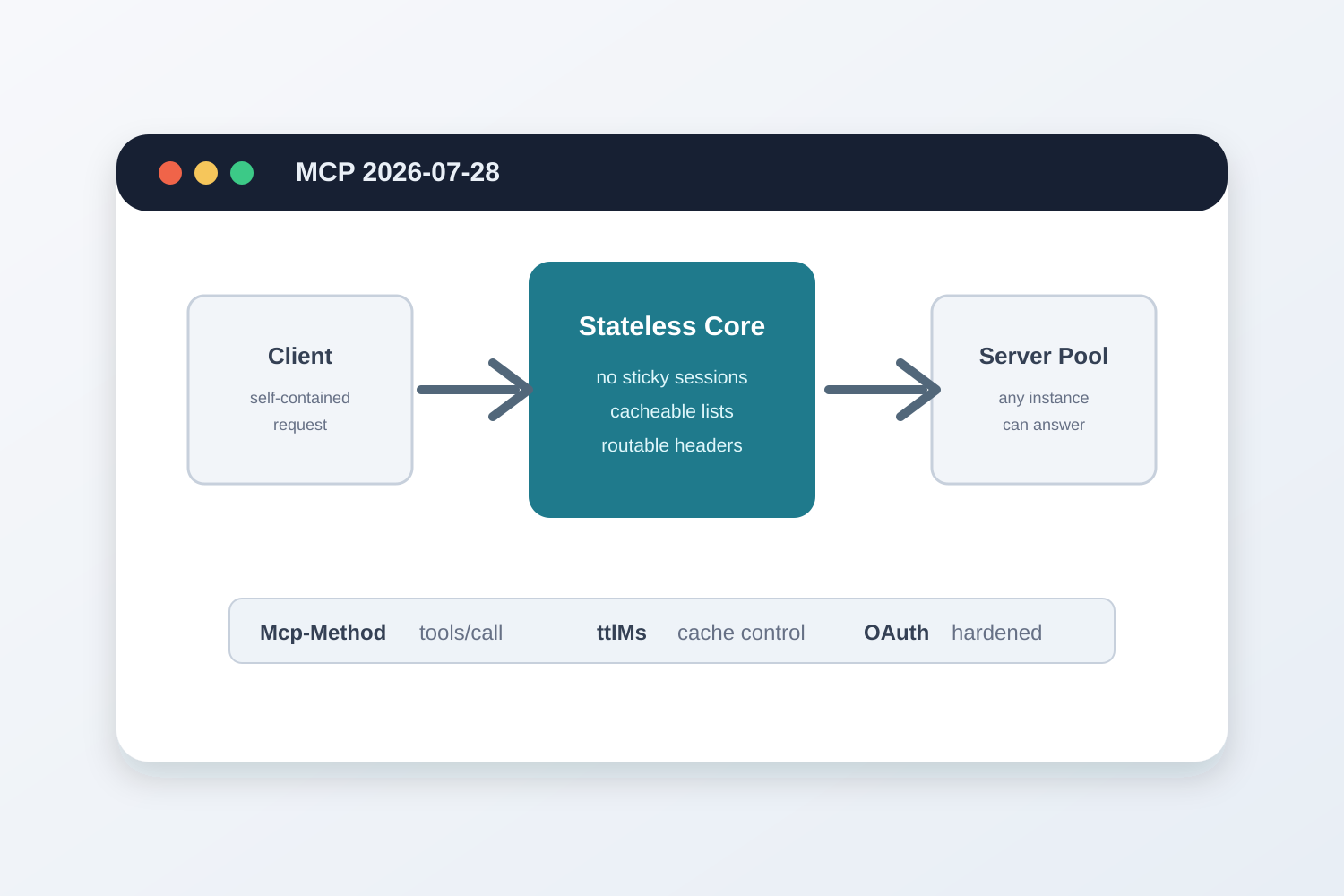
The Model Context Protocol just crossed an important line. The new 2026-07-28 specification is not a cosmetic update for AI agent developers. It is a production-infrastructure release: less session baggage, cleaner routing, better caching, tighter authorization, and a more explicit path for how MCP will evolve.
For business owners, the headline is simple: MCP is becoming easier to run at scale, which makes serious AI workflows less fragile and less expensive to operate. The end user may not notice a new button or a different chat interface tomorrow. Engineers will notice immediately.
What Changed
The biggest shift is that MCP is moving from a stateful protocol model to a stateless one. In the older setup, a server often had to remember a live session with the client. That meant sticky routing, shared session stores, and infrastructure that had to know which server instance was holding which conversation state.
In the new model, each request carries what it needs. Any server instance in a pool can answer it. That sounds like a narrow backend detail, but it is the kind of detail that decides whether an AI system stays reliable once more people start using it.
Think of it like moving from a restaurant where every customer must return to the same waiter for the whole meal to one where the order ticket is complete enough that any trained staff member can keep service moving. The customer experience gets smoother because the operation underneath gets less brittle.
Why Stateless MCP Matters
AI agents depend on external tools: CRMs, calendars, file systems, databases, search indexes, design tools, internal dashboards, and custom business systems. MCP is one of the standards trying to make those connections predictable.
When that connection layer is stateful, scaling gets awkward. Load balancers need special handling. Servers need shared memory or session databases. Failover gets harder. A failed server can interrupt the workflow because part of the context was attached to that server instead of the request itself.
With the 2026-07-28 spec, MCP takes a more cloud-native shape. Requests can move through ordinary HTTP infrastructure. Gateways can route traffic using headers like Mcp-Method and Mcp-Name without reading the whole message body. Clients can cache lists of tools and resources instead of repeatedly asking the server for the same menu.
The result is not just cleaner architecture. It is a better cost and reliability story for teams deploying agentic systems in the real world.
The New Request Pattern
One challenge with stateless systems is handling moments when the server needs more input. Maybe an agent starts a task and the server needs confirmation before deleting files, booking a meeting, or changing customer data.
The updated MCP spec handles that through Multi Round-Trip Requests. Instead of keeping a connection open while waiting for a human answer, the server returns a structured response saying input is required. The client collects the answer, attaches it to the retry, and sends the original request again with the necessary state included.
That matters because it keeps the workflow auditable and scalable. The server is not silently hanging onto a private thread of state. The next request carries the answer and the state needed to continue.
Security Gets Tighter
The release also hardens authorization around OAuth and OpenID Connect patterns. That is important because MCP servers often sit near valuable business systems. A sloppy authorization flow is not a theoretical problem when an agent can read records, trigger workflows, or modify operational data.
The spec also moves away from older registration assumptions toward more standardized client identity metadata. For companies building MCP servers, this is a signal: treat agent connectivity like real production software, not like a side experiment taped onto a chatbot.
What Is Being Phased Out
Roots, Sampling, and Logging are now deprecated, though not immediately removed. The maintainers are giving developers at least twelve months of runway before these features can disappear from future versions.
The replacements are more explicit. Roots can be handled through tool parameters, resource URIs, or server configuration. Sampling moves toward direct integration with model provider APIs. Logging shifts toward standard error for local transports and OpenTelemetry for structured observability.
This is a good trade. A protocol gets stronger when it stops trying to own every adjacent concern and focuses on the parts only the protocol can standardize well.
The Business Read
For most end users, this update will be invisible. That is the point. Infrastructure improvements usually show up as fewer broken workflows, faster responses, cleaner permission prompts, and cheaper systems to run.
For companies building with AI agents, the practical checklist is clear:
- Inventory any MCP servers that assume long-lived sessions.
- Check whether your gateway or load balancer depends on sticky routing.
- Review tool and resource list caching opportunities.
- Audit OAuth and authorization flows before connecting agents to sensitive systems.
- Plan migration away from deprecated Roots, Sampling, and Logging patterns.
This is not the kind of update that changes what AI agents can imagine. It changes what teams can responsibly deploy.
The Bottom Line
MCP’s 2026-07-28 specification is a maturity marker. The protocol is moving out of the early-tooling phase and into the infrastructure phase, where scale, routing, caching, observability, and authorization matter as much as the tool call itself.
If AI agents are going to become part of everyday business operations, the connective tissue has to be boring in the best possible way: predictable, secure, scalable, and inspectable. This release pushes MCP in that direction.
Sources:
Model Context Protocol: The 2026-07-28 Specification
Model Context Protocol: The 2026-07-28 MCP Specification Release Candidate
Pingback: Cloudflare Computer Shows Where AI Agents Are Really Going – Loudernet