
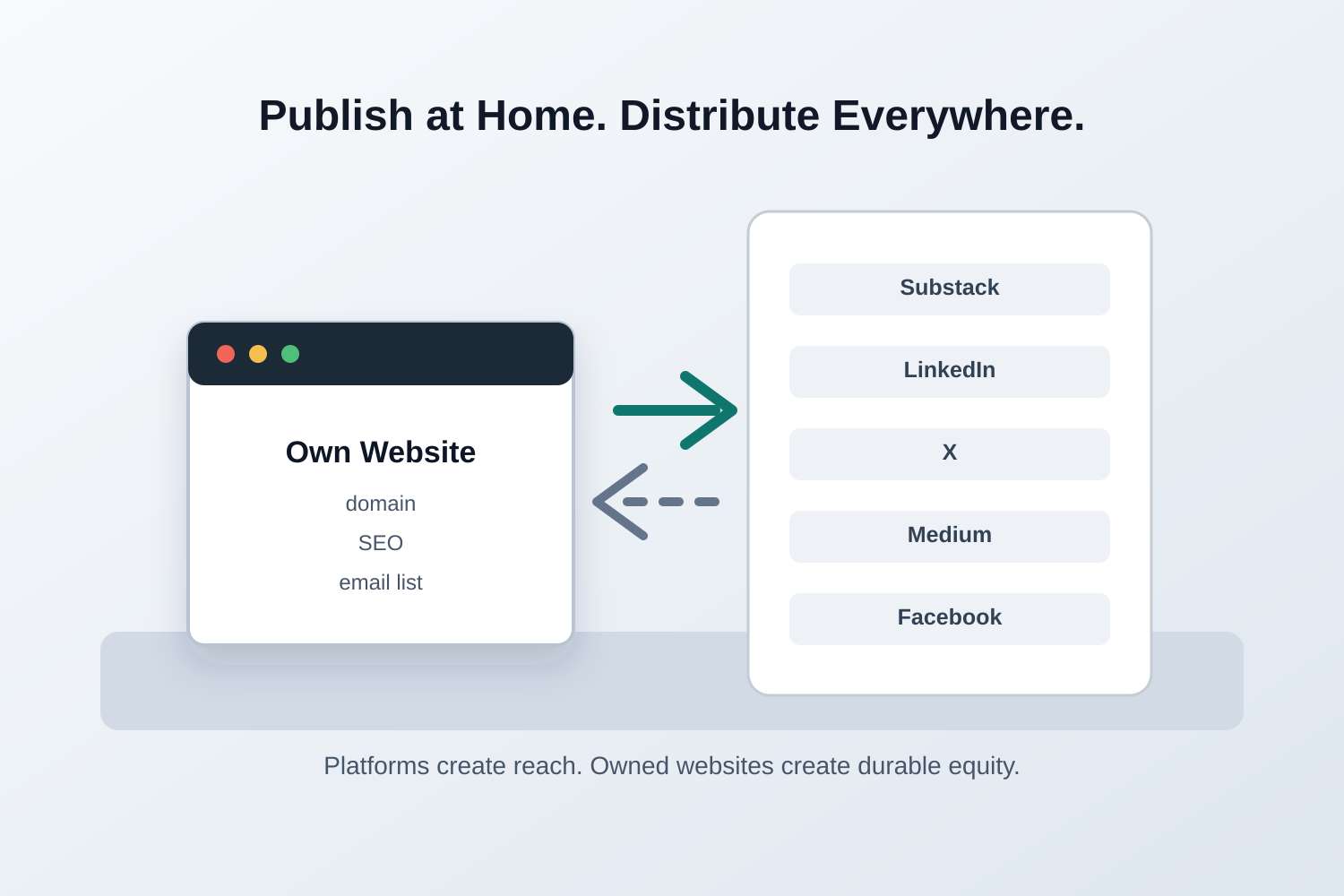
Elizabeth Tai’s argument to Substack writers is really an argument every business should hear: do not confuse a platform with a home.
Substack can be useful. So can LinkedIn, Instagram, Facebook, YouTube, Medium, TikTok, X, and whatever replaces half of them next year. Platforms can create reach, discovery, conversation, and momentum. But they are not assets in the same way an owned website is an asset.
The smart play is not to abandon platforms. The smart play is to stop letting platforms become the center of your digital presence.
The Website Is the Source of Truth
Tai’s post pushes back on a common line from writers: “I already have a website on Substack.” Her answer is blunt. Substack is a distribution tool. It should not be your digital home.
That distinction matters. A website on a domain you control gives your work a permanent address. It gives search engines a stable place to index your ideas. It gives readers, prospects, customers, and referral partners somewhere to land that is not filtered through another company’s design, policies, recommendation engine, or business model.
For writers, the risk is losing long-term visibility. For businesses, the risk is bigger. When your only meaningful presence lives on someone else’s platform, you are building demand in a space you do not control.
Platforms Are Distribution, Not Ownership
The convenience is seductive. A platform gives you templates, payments, audience features, comments, notifications, sharing, and analytics without much setup. That is useful. It is also how dependency starts.
Every major platform eventually changes. Organic reach drops. Rules shift. Account reviews get stricter. Features move behind paid plans. Algorithms favor a different format. A platform that once rewarded thoughtful writing starts pushing short-form outrage, video clips, paid boosts, or whatever keeps users scrolling longer.
None of this is personal. It is the platform acting like a platform.
If a third party controls the audience, the archive, the analytics, the design, and the delivery, you do not own the channel. You are renting attention.
Why This Is an SEO Problem
From an SEO standpoint, publishing only on rented platforms creates a compounding problem. Your best thinking, case studies, service explanations, answers, examples, and customer education are helping another domain get stronger.
That content may still bring you attention, but the long-term equity is diluted. Search engines learn the platform. Links point to the platform. Mentions reinforce the platform. Your brand becomes a tenant inside someone else’s authority.
An owned website changes the math. Every article, guide, FAQ, case study, service page, and resource can strengthen the domain you control. Over time, that creates durable search visibility. It gives AI search systems more structured context about who you are and what you do. It gives future customers a direct path to your business instead of a detour through a feed.
The Better Model: Publish Once, Syndicate Broadly
Tai points to the IndieWeb idea of POSSE: Publish on your Own Site, Syndicate Elsewhere. It is a simple operating rule with real strategic value.
Publish the original version on your website first. Then adapt it for Substack, LinkedIn, Facebook, X, email, YouTube descriptions, Google Business Profile updates, industry forums, or niche communities. The platforms still do what they are good at: distribution. But your website remains the canonical home.
This model works especially well for businesses because one strong article can become many distribution pieces:
- A full article on your website.
- A short email to your list.
- A LinkedIn post with a practical takeaway.
- A Google Business Profile update for local visibility.
- A short video script or talking point.
- A sales follow-up link for prospects asking the same question.
The same idea travels. The owned version stays home.
What Businesses Should Own
A real owned presence does not need to be complicated, but it does need to be intentional. At minimum, a business should control its domain, core website pages, analytics, email list, brand assets, and key educational content.
That foundation gives you leverage. You can change email providers. You can test new social platforms. You can run ads. You can publish newsletters. You can redesign. You can improve SEO. You can build tools, landing pages, lead magnets, booking flows, and customer portals.
Most importantly, you can keep moving even when a platform changes the rules.
The Real Takeaway
Substack is not the enemy. Neither is social media. The problem is treating any platform like permanent infrastructure when it is really borrowed distribution.
Your website should be the asset. Your platforms should be traffic sources.
That is the strategic difference. One compounds under your name. The other compounds under someone else’s.
For writers, creators, consultants, restaurants, contractors, professional firms, and local businesses, the rule is the same: publish where you own the ground, then distribute everywhere your audience spends time.
Source:
Elizabeth Tai: Substack writers, you need a website!