
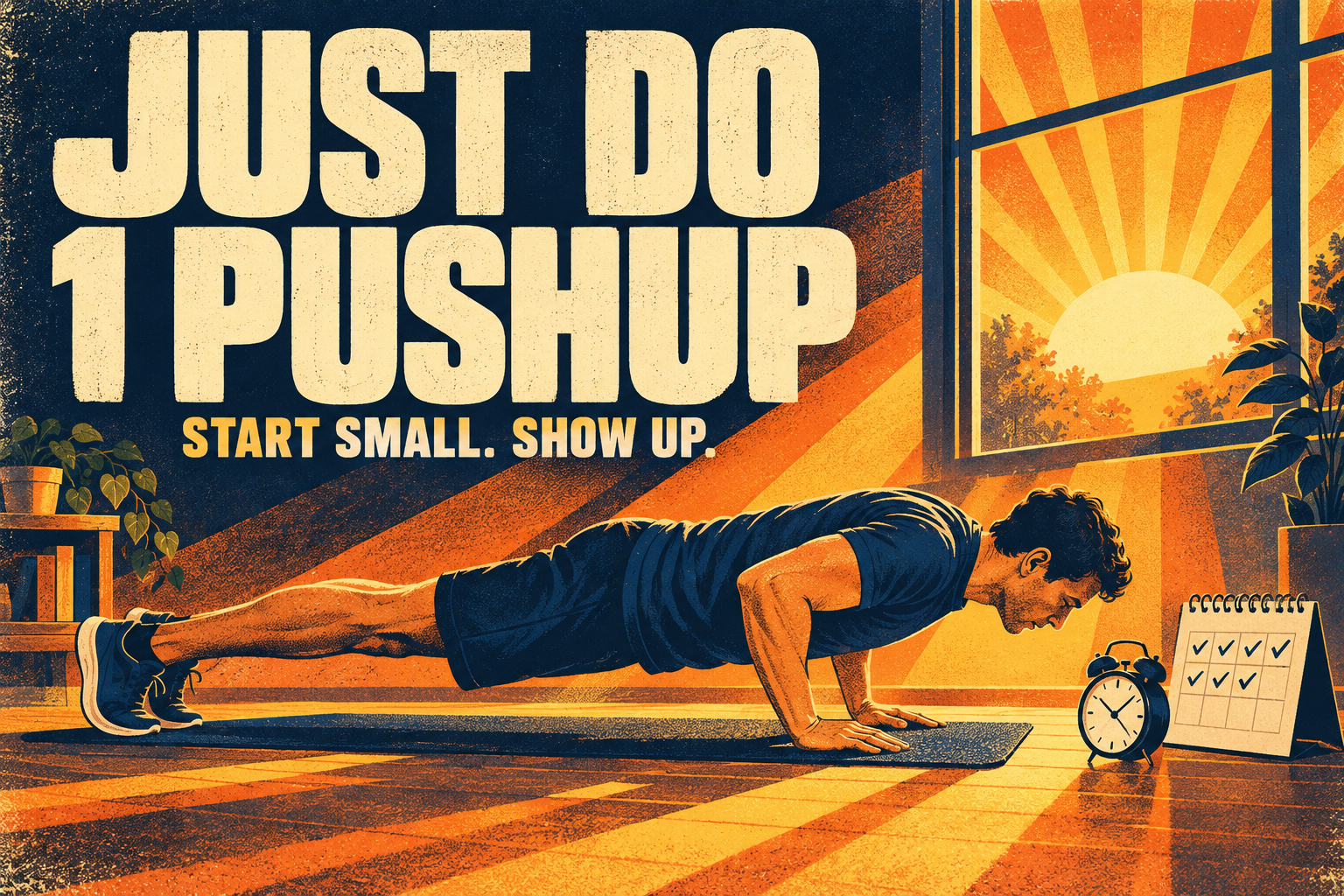
Some mornings, a 45-minute workout feels like a negotiation you have already lost. You are barely awake. The day is filling up. Before your feet reach the floor, you are calculating everything an exercise session will demand.
Try making the first request smaller.
Just do one pushup.
Not because a single repetition delivers the benefits of a full workout. Not because you can fool your brain into thinking you have trained for an hour. The point is simpler: make starting manageable enough that you are willing to do it again.
One pushup is a starting line, not a complete fitness program.
Make the first step smaller than the argument
A big exercise goal bundles several decisions together. When will you train? What will you wear? Which routine should you follow? Do you have enough time to finish?
The one-pushup approach separates the first action from the entire plan. Instead of committing to a demanding session, you commit to one comfortable, controlled repetition after a cue you can recognize.
For example: “After I brush my teeth in the morning, I will do one pushup.” If a floor pushup is not appropriate for you, choose a suitable wall version or another manageable movement.
This is a practical strategy, not a guarantee. Even a small action can be difficult on some days. The aim is to lower the requirement, not to make missing it a personal failure.
What motor-imagery research actually tells us
The Nautilus article that inspired this idea explores motor imagery: mentally rehearsing the experience of a movement without physically performing it. Imagery can engage parts of the systems involved in movement. Overlap, however, does not mean the experiences or training effects are identical.
In a 2004 study by Ranganathan and colleagues, participants practiced imagined contractions of specific finger or elbow muscles over 12 weeks. The researchers reported strength improvements following that structured mental training. This was a small, specialized experiment—not a test of one morning pushup, whole-body fitness, or habit formation.
That distinction matters. A pushup is an actual movement; motor imagery is mental rehearsal. Neither finding establishes that initiating one repetition produces the same brain response as completing a full workout. Nor does it show that a tiny action automatically removes resistance.
The defensible connection is modest: mental preparation and physical practice can each have a role in learning movement. The case for repeating a small morning action rests more directly on habit research.
Give the action a reliable place in your day
In Lally and colleagues’ real-world habit study, volunteers repeated an eating, drinking, or activity behavior in the same daily context. Repetition was associated with increasing automaticity—doing the behavior with less conscious deliberation. The time course varied substantially, and missing one opportunity did not materially disrupt the process.
That supports a useful principle: pair a repeatable action with a consistent cue. It does not prove this particular one-pushup routine will work for everyone or become automatic by a fixed deadline.
“I should exercise more” leaves the start undefined. “After brushing my teeth, I do my chosen movement” gives it a location in the day. Use a cue that fits your actual life, whether that is a morning routine, a lunch break, or the end of a workday.
Let momentum be optional
Sometimes one repetition may lead to another. Once you are on the mat, a short stretch or a planned session might feel more inviting.
Sometimes it will remain one.
Both outcomes fit the starting rule. If the minimum secretly becomes “one pushup, but really ten or it does not count,” you have rebuilt the larger demand you were trying to simplify.
Keep two questions separate:
- Did I practice starting? That is what the micro-action tracks.
- Am I getting enough appropriate exercise overall? That requires a broader plan.
You can also treat each completed action as a small piece of evidence that you make room for movement. That is a useful way to frame your progress, not proof of an instant neurological “identity shift.”
A simple way to try the one-pushup habit
- Choose a suitable movement. Pick an easy, controlled version that fits your abilities. Do not force a floor pushup to preserve the name of the habit.
- Attach it to one cue. Finish the sentence: “After I _____, I will _____.”
- Make the setup convenient. Choose a clear space so starting does not require rearranging the room.
- Count the minimum honestly. Mark that you completed the action. Extra repetitions are optional, not a hidden requirement.
- Return after a missed day. Resume at the next suitable opportunity instead of turning a lapse into an abandoned plan.
Keep the movement comfortable and stop if it causes pain. If an injury or health condition affects exercise, get guidance on an appropriate option rather than pushing through.
The spark still needs a larger fire
For general adult health, CDC guidance calls for at least 150 minutes of moderate-intensity aerobic activity a week, or 75 minutes of vigorous activity or an equivalent combination, plus muscle-strengthening activity on at least two days that works all major muscle groups. Activity can be spread across the week.
A single pushup does not meet those recommendations. Its proposed job is to make an entry point easier to repeat while you build an appropriate, sustainable routine.
Start small enough to begin. Build enough activity to serve your health.
Tomorrow, you do not need to negotiate your entire fitness future before breakfast. Choose your cue. Do your manageable first action. Let that be the beginning—not a claim that the work is already finished.
Adapted from the supplied “just do one pushup” draft, with research distinctions checked October 27, 2026. The suggested routine is a practical experiment, not a clinically validated one-pushup program.
Sources and further reading
- Nautilus: Just Imagining a Workout Can Make You Stronger — the inspiration for the motor-imagery discussion.
- Ranganathan et al.: From mental power to muscle power — primary research on structured mental contraction training.
- Lally et al.: How are habits formed? — primary research on repetition, context, and automaticity.
- CDC: Adult Activity—An Overview — the broader physical activity recommendations.