
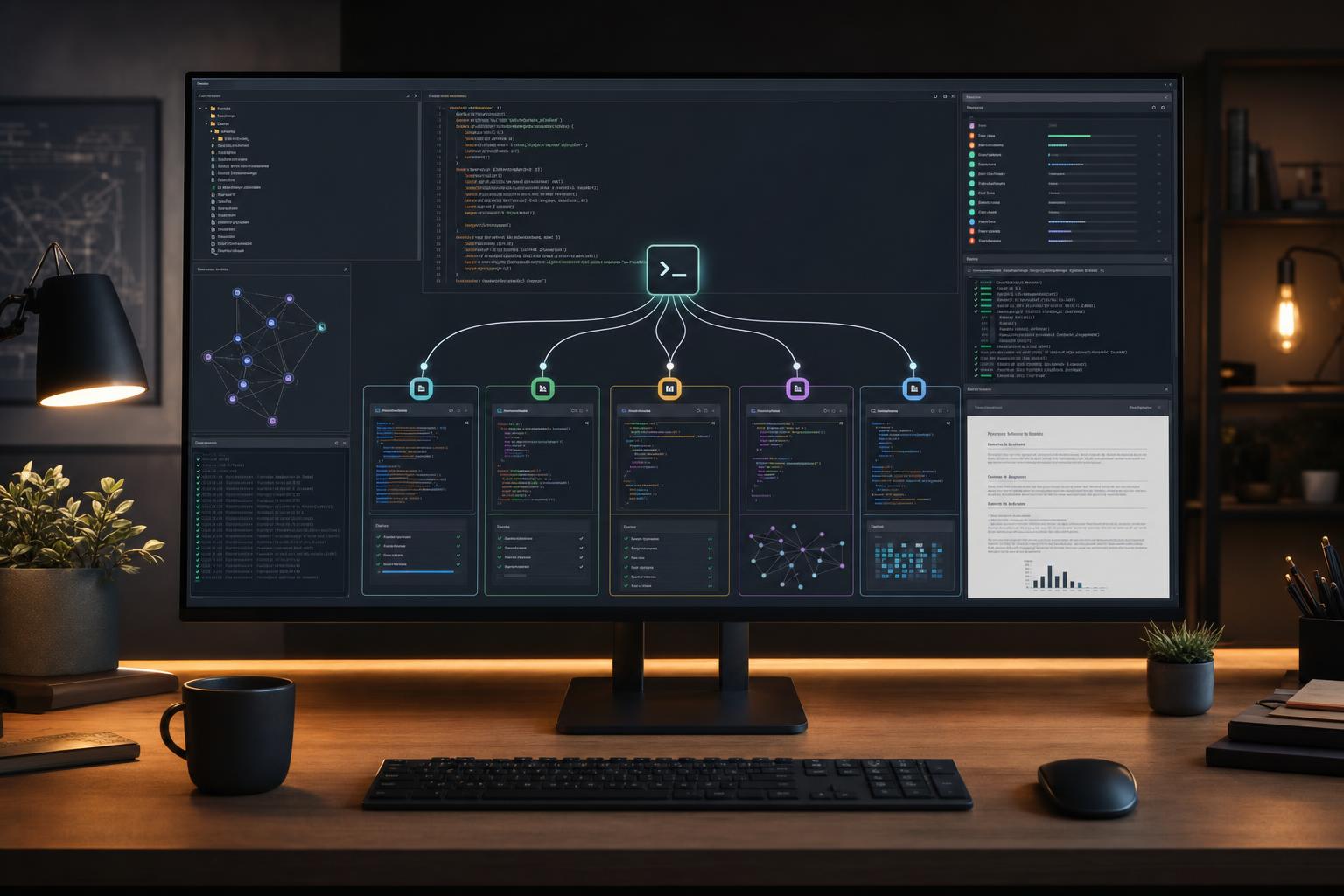
The New Stack tested Anthropic’s new dynamic workflows feature in Claude Code, and the result is a useful reality check for anyone treating AI coding agents like magic. The feature lets Claude write an orchestration script, launch multiple subagents in parallel, and pull the final result back together.
That is the important shift: AI coding is moving from one long conversation to managed workstreams. Instead of one agent trying to hold every task, decision, test result, and error in a single context window, dynamic workflows push orchestration outside the main chat and let specialized agents work at the same time.
The test
Jessica Wachtel compared dynamic workflows against a traditional single-agent Claude Code session. The task was small but realistic: build a CLI tool called codebase-health that could analyze a local codebase and produce a markdown report covering complexity, documentation, dependencies, and test coverage.
The dynamic workflow version split the job across five agents: one for complexity, one for documentation, one for dependency auditing, one for test mapping, and one final agent to wire the pieces together. It produced a working Python CLI in about seven minutes, with 62 passing tests and a sample report generated against its own repository.
The single-agent version also worked. It chose JavaScript, built a functioning CLI, and finished in a little under 11 minutes. It cost less, and in one area it handled an unsupported dependency audit more honestly by reporting that it could not find a supported manifest.
What stands out
The headline is not that dynamic workflows are suddenly perfect. They are not. Both versions missed the same dependency edge case because neither parsed setup.cfg. Both produced useful but imperfect first-pass tools. Both still needed an expert to review the output.
The real difference was structure. Dynamic workflows produced a more polished architecture, clearer separation of responsibilities, stronger test coverage, and built-in self-verification. For a small task, that advantage was modest. For a long migration, audit, refactor, documentation sweep, or multi-repo cleanup, that same architecture starts to matter a lot more.
Cheaper only matters if the job can actually finish. A single agent may look more efficient on a short task, but long jobs eventually run into context limits, drift, and accumulated uncertainty. Parallel agents are more expensive, but they give the system a way to divide the work before the context window becomes the bottleneck.
The business takeaway
For teams using AI coding tools, this is less about Claude specifically and more about where software work is headed. The winning pattern is not “ask one AI to do everything.” It is scope the work, assign the parts, verify the outputs, and keep a human accountable for the final call.
That starts to look less like prompting and more like management.
For business owners, the practical lesson is simple: AI coding agents are getting better at execution, but the leverage comes from orchestration. The person who knows how to break a project into clean components, define acceptance criteria, and test the final result will get far more value than someone who simply asks for a finished app and hopes for the best.
Dynamic workflows live up to the hype in the narrow sense: they make Claude Code feel less like a solo assistant and more like a coordinated development crew. But the larger lesson is sharper. AI is not removing the need for technical judgment. It is raising the return on it.