
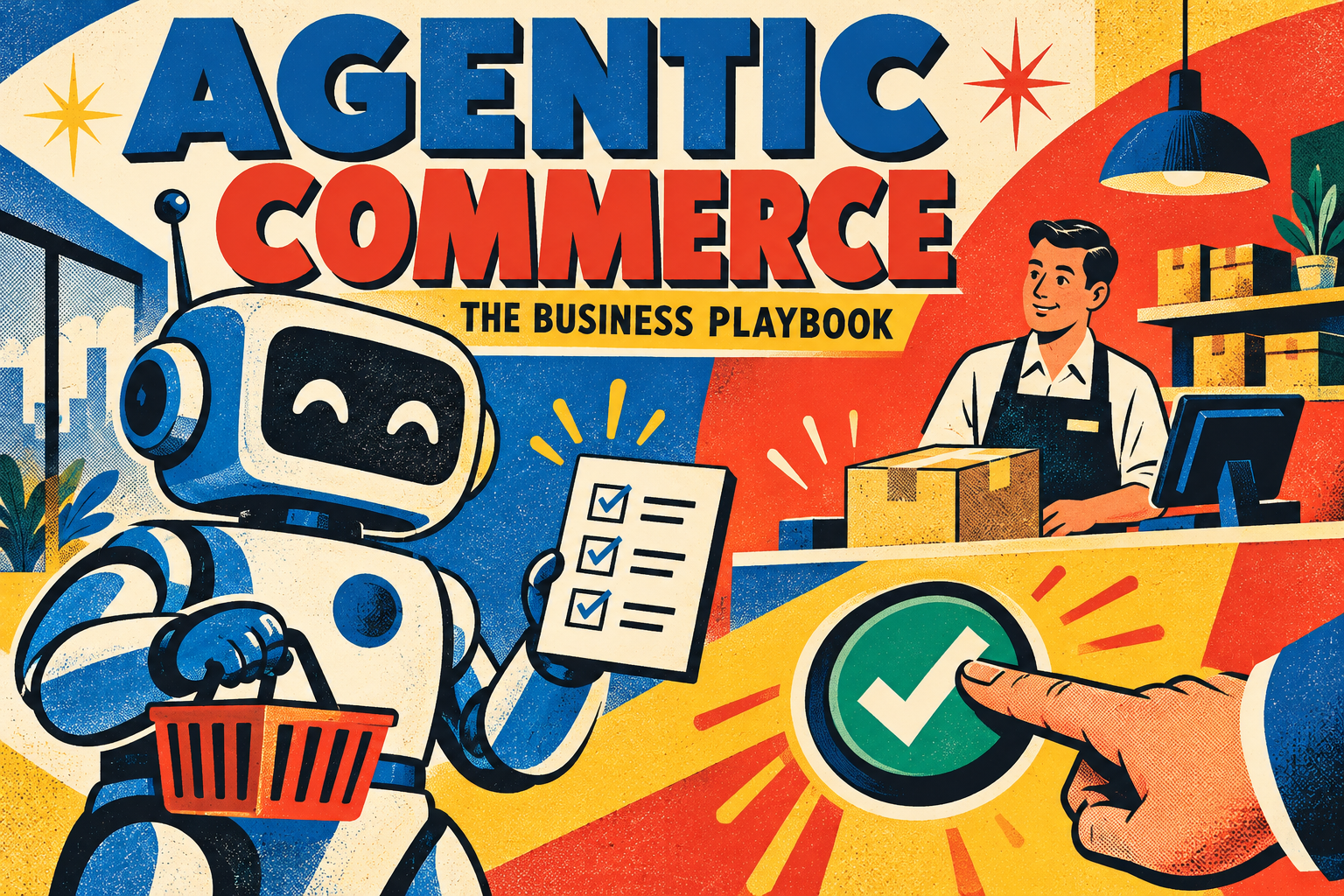
What happens when your next customer sends an AI assistant ahead of them?
The assistant might compare your offer, check availability, or help assemble a purchase. Your business still has to deliver what was promised. A polished recommendation cannot compensate for the wrong price, a failed checkout, or an order nobody knows how to explain.
American Express’s Business Playbook for Agentic Commerce is a useful starting point for that conversation. Its five chapters cover the basics, AI discoverability, transaction readiness, trust, and customer preference. The resource was announced October 6, 2026 and is free to access.
The opportunity is not simply getting AI to recommend your business. It is being ready to serve the customer when that recommendation turns into action.
AI-assisted does not mean fully autonomous
In the playbook’s introductory chapter, agentic commerce spans activities performed on a customer’s behalf, from research and comparison to purchases as capabilities develop. Amex distinguishes the more common assisted journey—where people still complete the purchase—from wider adoption of agents acting within customer-authorized limits.
That distinction matters. Helping someone decide what to buy is different from having permission to spend their money.
The playbook reports that 55% of surveyed U.S. consumers have used an AI agent for at least one purchase-journey activity. It also reports that 88% of surveyed U.S. merchants expect a moderate or significant business impact within three years. Neither figure measures the proportion of sales completed autonomously.
The underlying Amex Trendex research used online panels: 2,005 U.S. adults who reported at least three online purchases in six months, and 502 U.S. business leaders at companies accepting online or mobile payments, excluding franchisees. Conducted in August 2026, the surveys describe respondents’ behavior and expectations—not guaranteed results for your business.
Being understandable comes before being recommended
The AI-discovery chapter emphasizes clear descriptions, consistent facts, customer-style questions, and work with the providers that distribute business information. Rather than chasing a magic optimization trick, start by making the offer comprehensible.
For example, a retailer selling replacement filters could identify compatible models, package quantity, dimensions, and replacement intervals where those details are verified. A caterer could explain order minimums, lead times, delivery boundaries, and how dietary requests are handled.
These are not keyword decorations. They are decision inputs.
Our practical recommendation: choose one offering and compare its website description with the information in your store, marketplace, or booking platform. Resolve contradictions before writing more promotional copy. Record when important facts were checked and who owns the next update.
The checkout is only the middle of the job
Amex’s transaction-readiness chapter, with contributions from Stripe specialists, extends preparation beyond discovery. Accurate inventory, dependable fulfillment, payment support, returns, and customer service remain essential. It recommends working with existing providers and starting with a focused improvement.
For a small merchant, an immediate test could be tracing one item from its product page to checkout, confirmation, and pickup instructions. Does a stock change reach every sales channel? Are fees visible before payment? If pickup is unavailable today, does the customer learn that before placing the order?
A restaurant can apply the same thinking to online ordering or reservations. A service business can examine appointment availability and what happens after an inquiry. Not every business needs automated purchasing to benefit from a cleaner transaction journey.
Ask who can prove what the customer approved
The trust chapter addresses agent identity, customer permission, safeguards, and escalation. It explicitly advises understanding existing bot and fraud controls rather than lowering defenses to welcome automation.
Amex describes its ACE Developer Kit and an intended Agent Purchase Protection offering, while noting that some services and specifications remain in development and terms will apply. Treat those as evolving initiatives, not blanket protection already available for every AI-assisted order.
For your provider conversation, bring a specific scenario: a customer says an assistant ordered the wrong item. Ask what records your staff can access, who investigates authorization questions, and which support team handles escalation. Document the answer. A sales presentation about “AI readiness” is not a substitute for a usable support path.
Give the shortlist a reason to choose you
The final chapter separates visibility from preference: appearing among the options does not explain why your business is the best fit. It also notes that how loyalty and brand relationships carry into third-party AI experiences is still developing.
Make your real advantage explicit. If you provide installation, describe its scope. If customers choose you for specialty expertise, show the relevant experience. If convenient collection matters, publish the actual collection arrangements. Avoid claims such as “best service” when a concrete promise would be more useful.
A first project you can finish in two weeks
This is Loudernet’s suggested implementation exercise, not an Amex requirement:
- Choose one purchase path. Select a product or service that customers already research online and that your team can support reliably.
- Capture the baseline. Record its completed orders or qualified inquiries, common questions, and recurring fulfillment problems.
- Repair one gap. Clarify an important product detail, resolve inconsistent availability, or fix the next step after checkout.
- Review with your providers. Ask which agent-assisted capabilities they support now, which are planned, and whether you need to change anything.
- Evaluate the outcome. Look for fewer avoidable questions or failed handoffs. Do not assume every improvement came from AI traffic, and allow more time before drawing conclusions from small samples.
Prepare for agentic commerce by making one real customer journey work better—not by rebuilding the business around an unproven forecast.
The Amex playbook is worth reading because it connects the AI conversation to the work merchants already understand: explain the offer, complete the transaction, and look after the customer.
Source: Amex Business Playbook for Agentic Commerce and its linked chapters. This article adds Loudernet’s independent business analysis; it is not sponsored by or affiliated with American Express.