
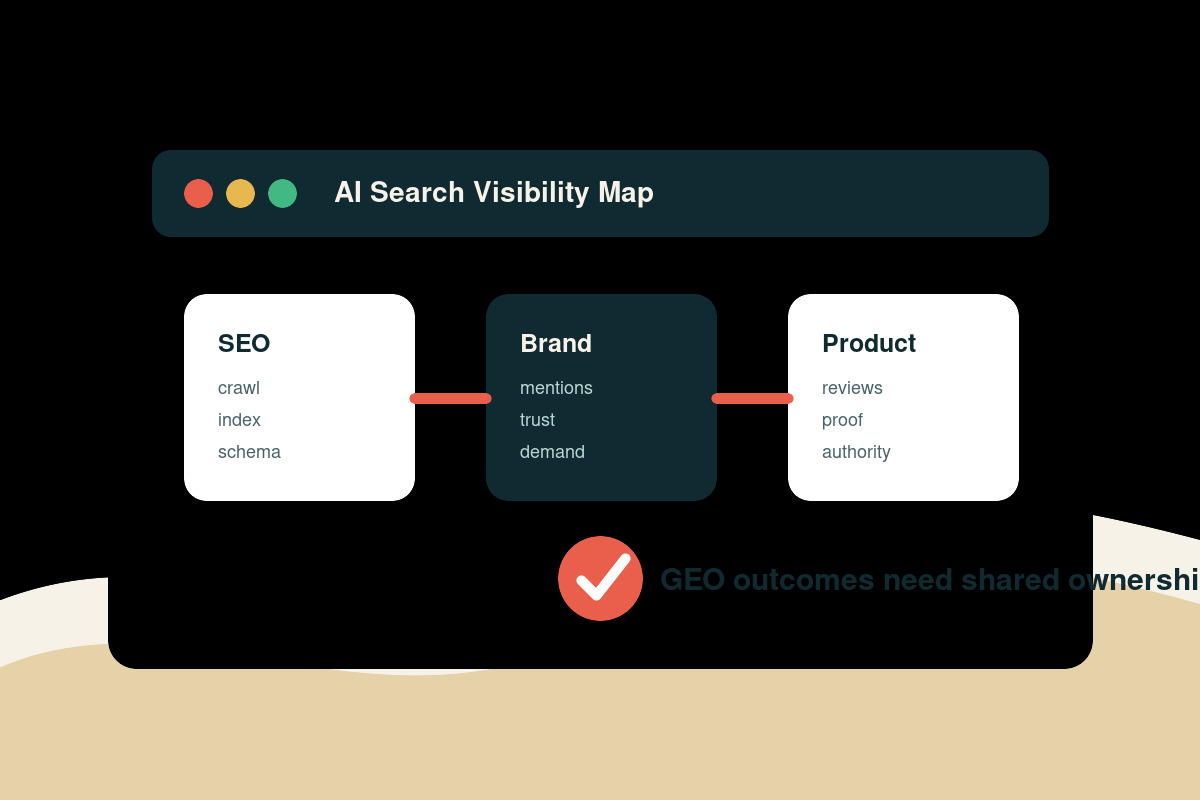
AI search is forcing a hard conversation that many SEO teams have avoided: visibility is no longer controlled by technical optimization alone. In a recent Search Engine Journal article, Roger Montti covered comments from search marketer Tom Critchlow arguing that generative engine optimization is exposing a bigger ownership problem inside companies.
The short version: SEO can build the foundation, but AI search outcomes are increasingly shaped by brand, product, PR, reviews, reputation, and editorial proof. That changes who needs to be in the room.
The uncomfortable part of GEO
Classic SEO rewarded solid technical work, strong content, internal links, crawlable pages, and authority signals. Those still matter. AI search has not erased the basics.
But when a person asks ChatGPT, Perplexity, Gemini, or Google AI Mode which company to trust, the answer is not built from title tags alone. It is pulled from a wider market memory: third-party mentions, product sentiment, expert references, social proof, customer reviews, pricing pages, comparison content, forum discussions, and the general shape of a brand’s reputation online.
That is why this matters for business owners. If the AI answer recommends a competitor, the fix probably is not one more keyword page. The fix may be better proof in the market.
SEO is becoming the coordinator, not the sole owner
The strongest SEO teams will still handle crawlability, indexation, content architecture, structured data, topical coverage, and measurement. Those are table stakes.
The new job is broader. SEO needs to identify what AI systems are likely seeing, then push the organization toward the inputs that change those answers. That can mean working with product teams on clearer differentiators, with PR teams on earned mentions, with sales teams on objections, and with leadership on positioning.
For local and service businesses, the same pattern applies. Your Google Business Profile, local citations, review language, neighborhood relevance, service pages, case studies, and third-party mentions all become part of the answer layer. GEO is not a magic replacement for SEO. It is SEO colliding with brand reality.
What companies should do now
Start by testing the questions real buyers ask. Compare prompts across AI search tools, track which competitors appear, and document the sources those systems seem to lean on. Then look for gaps: missing comparison pages, thin service explanations, weak review velocity, inconsistent business information, no authoritative mentions, or unclear proof that the company is the right choice.
From there, treat AI visibility as a cross-functional operating problem. Build pages that answer commercial questions directly. Strengthen brand mentions outside your own website. Make reviews more specific. Publish proof, not filler. Keep technical SEO clean so AI crawlers and traditional search engines can understand the site.
The companies that win GEO will not be the ones that rename SEO and call it done. They will be the ones that align search, brand, content, product, and reputation around the same market story.
The Loudernet take
This is the practical shift: SEO is moving from page-level optimization toward outcome orchestration. The work still starts with a strong website, but it does not end there.
For business owners, that means asking a sharper question than “are we ranking?” Ask: when AI systems describe our category, do we show up as a trusted answer? If not, the path forward is bigger than metadata. It is brand evidence, published clearly and reinforced everywhere buyers look.
Source: Search Engine Journal, “AI Search Is Exposing SEO’s Risk Of Losing Ownership Of GEO Outcomes,” by Roger Montti, published July 8, 2026.